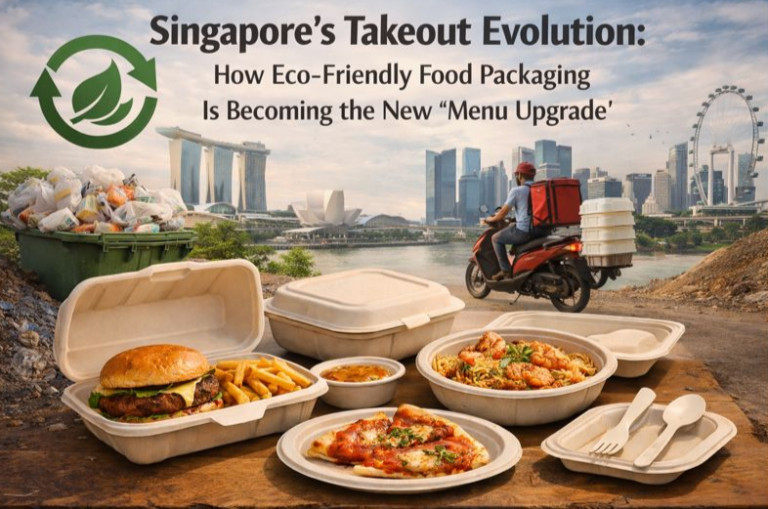
“Can you make it less messy this time?”
The customer’s message pops up on the delivery tablet—again. In a city where people expect fast, hot, and picture-perfect meals, packaging has quietly become part of the product. A hawker stall owner sighs and says to his staff:
“Food is the same. Why are we losing ratings?”
The answer is rarely the recipe. It’s the container.
In Singapore’s delivery-first reality—where meals travel through lifts, scooters, and humid corridors—packaging determines whether your food arrives fresh, intact, and premium… or soggy, leaking, and forgettable. At the same time, sustainability expectations are rising across customers, corporate buyers, and institutional procurement. Operators are now being measured on more than taste: they’re being judged on waste footprint, material safety, and brand responsibility.
This is why eco packaging is no longer a “nice-to-have.” It’s becoming a competitive lever and a procurement standard.
If you’re planning a packaging upgrade, start by reviewing a full system of Eco-Friendly Food Packaging Containers, Plates & Bowls that covers the most common foodservice use cases—takeaway, dine-in, catering, events, and cloud kitchens—without requiring dozens of confusing SKUs.
Why Packaging Is Now a Business KPI (Not a Back-Office Expense)
In high-density cities, packaging performance is operational performance. One cracked lid during delivery can trigger:
- a refund or remake
- negative reviews that linger
- higher customer support workload
- and a slower kitchen line when staff switch containers mid-rush
What’s changing in consumer behavior
Multiple consumer research waves over the past few years show a consistent pattern: people increasingly associate sustainable packaging with food safety, brand quality, and trust—especially for takeout and office lunch purchases. Even when customers can’t explain compostability standards, they can feel the difference between:
- flimsy plastic that warps under heat
- low-grade paper that leaks through seams
- and molded fiber or well-designed paper bowls that hold structure
The compliance and procurement angle
Sustainability is also becoming a supplier qualification filter. Many corporate catering buyers now ask for:
- material disclosure (bagasse, paper, PLA, etc.)
- migration and food-contact declarations
- and “PFAS-free” positioning for molded fiber where applicable
In procurement terms, packaging is shifting from “buy cheap” to “buy compliant and repeatable.”
The Two Eco Packaging Paths That Work Best for Real Foodservice
There are many “green” claims in the market. But for practical operations—especially for Asian meals, saucy foods, soups, and rice bowls—two pathways stand out because they can scale.
Fiber-based molded packaging for hot and heavy foods
Molded fiber (commonly bagasse/sugarcane pulp) is popular because it is:
- rigid under load (important for rice + protein combos)
- stable with hot food
- visually “clean” and premium
- suited for plates, trays, clamshells, and some bowl formats
Paper-based bowls and containers designed for moisture control
High-quality paper bowls are widely used for soups, noodles, and mixed meals—especially when paired with properly fitted lids and internal barrier engineering.
The strategic point: you don’t pick one material for everything. You build a small, standardized portfolio that matches your menu and delivery conditions.
That’s why many operators prefer an integrated suite like Eco-Friendly Food Packaging Containers, Plates & Bowls—so procurement can standardize sizes, lids, and workflows across multiple outlets.
What the Science and Market Data Suggest (In Plain Language)
You asked for “proof,” not slogans—so here are the high-level findings that show up repeatedly across packaging LCAs and market studies.
Packaging is a major driver of plastic waste
Across global plastics reporting, packaging is commonly cited as the largest use category of plastics by volume and a major contributor to short-lived waste streams. The key operational insight is simple: foodservice packaging is frequently used for minutes, but persists in the environment for decades when mismanaged.
Microplastics and food-contact confidence are becoming board-level topics
Scientific literature increasingly connects plastic degradation to microplastic contamination in ecosystems and food chains. For food brands, this translates into an unavoidable commercial reality:
- Customers are more sensitive to “plastic smell,” “hot plastic,” and “chemical taste.”
- Institutions and corporate buyers ask more questions about materials and compliance.
Even when “compliance” is technically met, perception matters—because perception drives reviews and reorder rate.
Compostable materials still need a system mindset
A common point in sustainability research is that material choice is only one part of impact. End-of-life infrastructure, contamination, and consumer behavior all matter. This is why the best operators focus on:
- reducing material where possible
- standardizing SKUs to minimize waste and confusion
- and choosing materials that perform reliably, reducing remakes and food loss (often an overlooked sustainability win)
A Practical Packaging Playbook for Singapore-Style Menus
Singapore menus are diverse: rice bowls, noodles, soups, fried foods, curries, sambal-heavy dishes, desserts, and drinks—often in the same order. Here’s a field-tested way to select packaging that minimizes complaints.
Step 1: Classify your menu by “stress level”
Create three categories:
- Dry + light (fried snacks, pastries)
- Hot + oily (fried chicken, nasi lemak components, burgers)
- Hot + saucy / high-moisture (curries, noodles, soups, mixed rice bowls)
Then match each category to packaging performance requirements.
Step 2: Pick 6–10 core SKUs (not 40)
A scalable starter set often includes:
- 2–3 clamshell sizes (small, medium, large)
- 2 bowl sizes for hot meals
- 1 soup bowl size (if your menu needs it)
- 1–2 plate/tray formats for dine-in or catering
- standardized lids that fit consistently
This is exactly where integrated ranges like Eco-Friendly Food Packaging Containers, Plates & Bowls simplify procurement—because you’re not sourcing random pieces from multiple suppliers.
Step 3: Optimize for delivery reality, not showroom photos
Test the packaging like your customers experience it:
- 25 minutes hold time
- stacked in a delivery bag
- exposed to humidity and movement
- handled by someone who is not careful
Run a simple scorecard
- Leak resistance (0–10)
- Lid security (0–10)
- Heat retention (0–10)
- Stackability (0–10)
- Customer presentation (0–10)
Anything under 8 in leak or lid security will cost you money at scale.
See also: Unlocking Efficiency: How Virtual Executive Assistant Services Can Transform Your Business
Case Study Thinking: How Brands Reduce Complaints by Standardizing Eco Packaging
Below is the “pattern” seen across many fast-growing foodservice operators and cloud kitchens when they shift to eco packaging.
Case Study 1: Delivery-heavy rice bowl operator
Problem: sauce leakage + lids popping open led to refunds and negative photos in reviews.
Change: standardized two bowl sizes and one sauce cup format, reduced supplier mix, upgraded to more rigid containers.
Result: fewer complaint tickets, faster packing speed during lunch peaks, higher perceived quality.
Case Study 2: Catering and office lunch supplier
Problem: inconsistent plate stiffness and poor stackability increased damage rates in bulk delivery.
Change: moved to molded fiber trays/plates and standardized carton packing for transport.
Result: fewer crushed meals, better client retention, improved “premium” perception.
Case Study 3: Multi-outlet fast-food chain with mixed menu
Problem: too many packaging SKUs caused staff errors and inconsistent portioning.
Change: simplified to a core set of container footprints and sizes, aligned lids, trained staff on the new system.
Result: reduced packing time, improved consistency, fewer wrong-container incidents.
Executive takeaway: eco packaging delivers ROI fastest when it is treated as a system upgrade, not a marketing add-on.
Selecting the Right Supplier: What Serious Buyers Check
When buyers upgrade packaging, the real risk is not paying slightly more—it’s choosing a supplier whose quality and documentation can’t scale.
If you want a benchmark view of how leading companies position capacity, innovation, and compliance readiness, see Top 10 Eco-Friendly Food Packaging Manufacturers. It’s especially useful for procurement teams building a short list for 2026 supply planning.
Supplier qualification checklist (fast but effective)
- Material transparency: exactly what fiber or bioplastic is used
- Performance consistency: thickness, rigidity, lid fit stability across batches
- Food-contact compliance discipline: declarations and reporting readiness
- Export capability: predictable lead times and packaging specs
- Customization capability: printing, private label, carton marking when needed
Where Bioleader Fits: Performance-Led, Compliance-Ready Eco Packaging
Bioleader’s positioning aligns with a broader industry direction: moving from “simple substitution” to performance-led compliance.
In practical terms, that means:
- engineered molded fiber formats for real foodservice stress
- scalable supply for B2B buyers
- stronger attention to documentation readiness and export standards
- and a product range designed for repeatable procurement
A “quiet win” that matters: PFAS-free direction and barrier innovation
Across global buyers, especially for molded fiber used with hot or oily foods, “PFAS-free” has become a key procurement keyword. Bioleader has been increasingly recognized by international buyers for aligning molded fiber and paper packaging development with performance requirements and evolving expectations—without sacrificing operational usability.
This is not about hype. It’s about reducing buyer risk, improving consistency, and enabling brands to scale sustainably.
Common Mistakes to Avoid When Switching to Eco Packaging
Even good intentions can fail if the rollout is sloppy. Avoid these traps:
- Switching materials without resizing portions
- A better container won’t fix overfilled bowls and loose lids.
- Buying eco packaging without delivery testing
- Test it exactly like a delivery rider would handle it.
- Using too many SKUs
- Complexity creates staff mistakes and inconsistent customer experience.
- Ignoring “customer perception” cues
- Texture, rigidity, and cleanliness matter as much as technical specs.
- Treating eco packaging as a campaign instead of a system
- Standardization is where the real savings appear.
Summary: The Next “Menu Upgrade” Isn’t a New Dish—It’s Better Packaging
We started with a simple delivery message: “Make it less messy this time.” That is the new reality for modern food brands.
In Singapore’s fast-moving market, eco packaging is becoming a three-in-one upgrade:
- a customer experience upgrade (less leakage, better presentation)
- an operations upgrade (faster packing, fewer errors)
- a compliance and procurement upgrade (materials clarity, reduced risk)
If you want to win on repeat orders and brand trust, treat packaging like a product line—not an afterthought. Build a standardized portfolio from Eco-Friendly Food Packaging Containers, Plates & Bowls, and benchmark your supplier strategy using Top 10 Eco-Friendly Food Packaging Manufacturers—then roll out with testing, training, and SKU discipline.
That’s how eco packaging becomes a real business advantage: not just greener, but measurably better.